It’s 11:47 PM.
You spent half the day trying to concentrate on things you actually needed to do.
Emails took forever. You started three tasks and finished none of them. You walked into a room and forgot why you were there.
You should probably go to bed.
And suddenly...
your brain is absolutely cooking.
You need to research a hobby you've never previously expressed any interest in. You remember a project you've been putting off for a week and decide now is the perfect time to start it.
One YouTube video becomes six.
You reorganize a drawer.
You somehow end up reading about whether octopuses dream.
And eventually you look at the clock.
1:36 AM.
If you have ADHD, this might sound painfully familiar.
And it turns out the relationship between ADHD and sleep is much stranger than simply being bad at going to bed.
ADHD and sleep are deeply connected
Sleep problems are remarkably common among adults with ADHD.
Research has found higher rates of difficulty falling asleep, disrupted sleep and later sleep timing among people with ADHD.
But scientists have noticed something particularly interesting.
For some people with ADHD, their entire internal clock appears to run later.
Studies have associated adult ADHD with greater “eveningness,” later waking and delayed circadian rhythms. Researchers measuring melatonin, one of the hormones involved in regulating our sleep-wake cycle, have even found later melatonin onset in some adults with ADHD and sleep-onset insomnia.
In other words, when everyone else is winding down...
some ADHD brains may genuinely be running on a later clock.
But there's another reason nighttime feels different
Think about what happens at night.
The emails stop.
The meetings stop.
Nobody needs anything from you.
There are fewer decisions to make and fewer interruptions competing for your attention.
For perhaps the first time all day, the world becomes quiet.
And that can make nighttime incredibly appealing.
There's even a term for a related behaviour: bedtime procrastination.
It means going to bed later than you intended despite there being no external reason preventing you from going to sleep.
You've finished work. Nothing is happening. You could go to bed.
You just... don't.
Sometimes you'll hear the phrase “revenge bedtime procrastination” used to describe the feeling that nighttime is the only part of the day that truly belongs to you.
After spending all day doing things you had to do, going to sleep feels strangely like surrendering the small piece of time when nobody is making demands of you.
So you steal another hour.
Unfortunately, you're stealing it from tomorrow.
ADHD can make that bargain even harder
ADHD isn't simply an inability to pay attention.
It can involve difficulty regulating attention.
Something boring struggles to hold you.
Something interesting can hold you for hours.
That distinction becomes rather important at midnight.
“Go upstairs, brush your teeth and go to sleep because tomorrow will be better if you do” offers your brain very little immediate reward.
The video you're watching does.
So does the game.
So does whatever fascinating rabbit hole you've just discovered.
And bedtime requires something else that can be difficult when your executive function is already depleted:
stopping.
You don't just have to become tired.
You have to disengage from whatever you're doing, resist another immediately rewarding activity, initiate a boring sequence of bedtime tasks and voluntarily choose unconsciousness.
When you put it like that, bedtime is basically an executive-function obstacle course.
Then things get really weird
Because the relationship runs in both directions.
ADHD can make sleep difficult.
But poor sleep can also make attention more difficult.
Sleep deprivation affects sustained attention, working memory, mood and our ability to regulate ourselves.
Which can create a pretty unpleasant feedback loop:
You struggle to regulate your attention.
So you stay up later.
You sleep less.
The next day, you're tired.
Being tired makes attention and self-regulation harder.
You stumble through the day.
Then nighttime arrives.
The world becomes quiet again.
And suddenly you feel alive.
So you stay up.
Again.
Which raises an interesting question
If you're constantly distracted, forgetful, irritable and struggling to concentrate...
how much is your attention, and how much is your sleep?
This absolutely does not mean ADHD is secretly just sleep deprivation.
ADHD is a real neurodevelopmental disorder, and sleep problems are neither necessary nor sufficient for an ADHD diagnosis.
But the overlap matters.
Sometimes you're dealing with ADHD.
Sometimes you're dealing with inadequate sleep.
And sometimes you're dealing with both, each making the other considerably more annoying.
The goal isn't to knock yourself out
One of the most useful ways to think about sleep is that it's a transition, not an on/off switch.
Your body has an entire system devoted to moving between wakefulness and sleep.
Light changes.
Body temperature changes.
Melatonin rises.
Activity in different neurotransmitter systems changes.
And one of the major chemical messengers involved in turning down activity in the brain is GABA, or gamma-aminobutyric acid.
GABA is the brain's primary inhibitory neurotransmitter. In extremely simplified terms, if some neurotransmitters are helping neurons shout, GABA helps tell them to quiet down.
That's one reason GABAergic signalling is so interesting to sleep researchers.
There has also been research into oral GABA supplementation. Some small human studies have reported improvements in measures such as the time it takes to fall asleep and sleep efficiency, although the overall evidence is still developing.
Then there are ingredients humans have been using long before we knew what a neurotransmitter was.
Reishi mushroom has a long history of traditional use around rest and relaxation, and modern research has begun investigating the biological mechanisms that might sit behind some of those traditional uses.
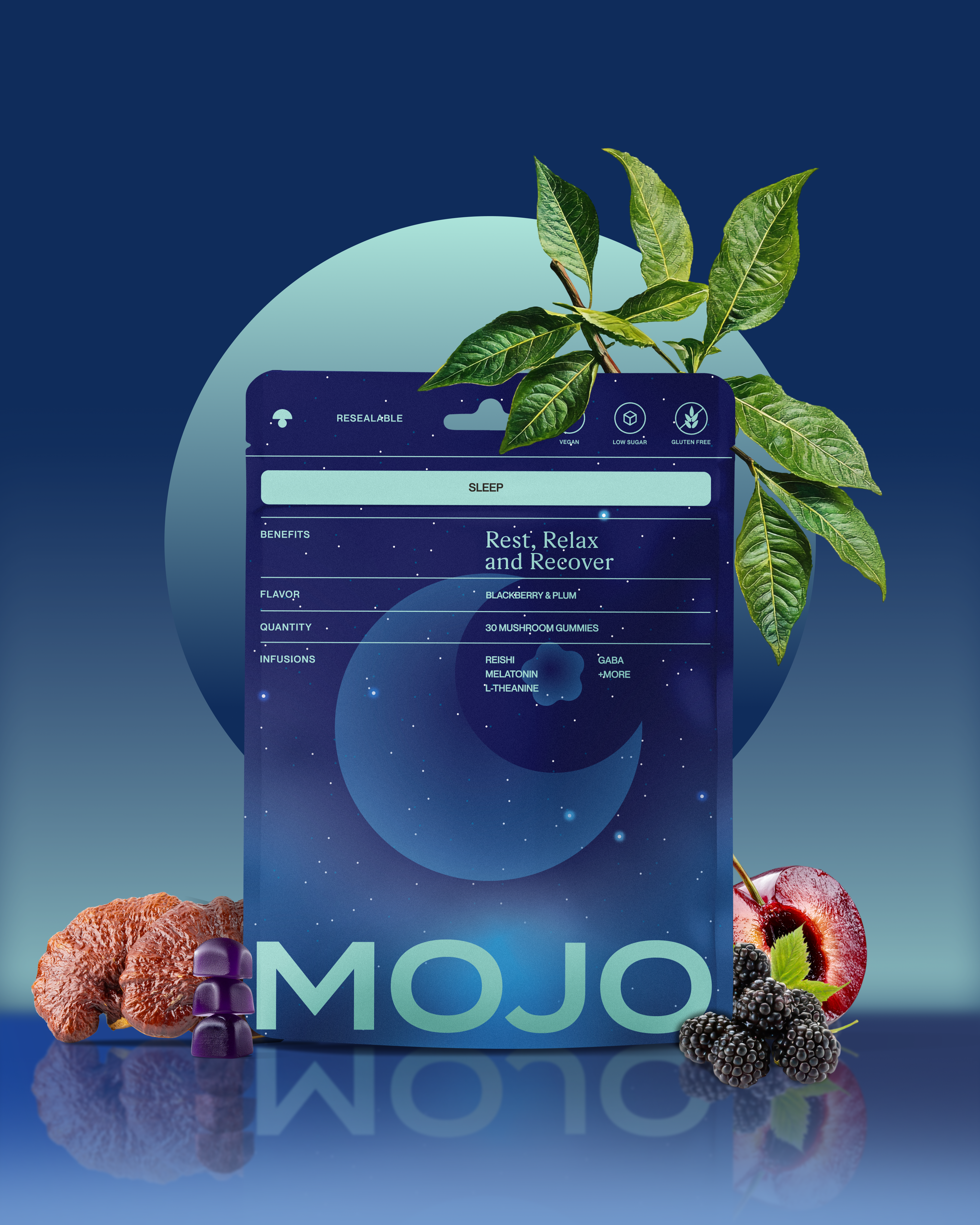
That's why we included ingredients like GABA and reishi in Sleep Mojo.
Not because a gummy can override terrible sleep habits.
And not because the goal should be to chemically bludgeon yourself unconscious.
The idea is much simpler:
help your brain get the message that the day is over.
Make sleep easier to start
If your brain tends to come alive at exactly the wrong time, don't rely entirely on willpower.
Give yourself a stopping cue.
Make nighttime deliberately less stimulating.
Dim the lights.
Put the phone somewhere slightly inconvenient.
Get daylight earlier in the day.
Give yourself some separation between your final blast of stimulation and trying to sleep.
And perhaps most importantly, stop treating sleep as whatever time is left over after you've finished everything else.
Work gets scheduled.
Exercise gets scheduled.
Dinner gets scheduled.
Entertainment gets scheduled.
Sleep gets the scraps.
But if attention is already something you struggle with, consistently giving your brain less sleep is a particularly bad bargain.
Because that midnight burst of hyperfocus might feel fantastic.
Tomorrow morning probably won't.
Table of contents