There’s a moment in the day that almost everyone recognizes.
You’re not tired enough to stop.
But you’re not sharp enough to do anything meaningful.
You open a tab.
Close it.
Check your phone.
Forget what you were doing.
It’s somewhere between 2 and 4 PM.
And it’s not just in your head.
This Is When Your Brain Drops Off a Cliff
Most people assume energy declines gradually throughout the day.
It doesn’t.
It dips. Hard.
Your body runs on a circadian rhythm, your internal 24-hour clock that regulates sleep, wakefulness, and energy.
But layered on top of that is something most people don’t think about: ultradian rhythms. These are shorter cycles that control focus and alertness in 90–120 minute waves.
By the time you hit mid-afternoon, both systems are working against you.
Your morning cortisol spike is gone.
Your body temperature starts to dip.
Adenosine, the chemical that creates sleep pressure, has built up.
And your blood sugar begins to fluctuate after lunch.
The result is a very real biological drop in performance.
Not gradual. Sudden.
The Data Is Actually Kind of Wild
This isn’t just about “feeling a bit off.”
Across industries, the same pattern shows up.
Car accidents increase in the early afternoon.
Workplace mistakes rise.
Reaction times slow.
Focus and vigilance drop.
Decision-making quality declines.
Even in hospitals, serious errors are more likely later in the day than in the morning.
We structure our days like performance is constant.
But the data says otherwise.
Why Pushing Through Doesn’t Work
Most people respond the same way.
More coffee.
More force.
More tabs.
But the problem isn’t effort.
It’s timing.
You’re trying to override a system-level dip with willpower. That rarely works for long.
It’s like trying to sprint uphill when your legs are already cooked. You might move forward, but the output is worse, and the cost is higher.
This is where a lot of modern work breaks down.
We optimize calendars.
We stack meetings.
We fill every hour.
But we ignore the one variable that actually determines output.
Energy.
The Real Shift: Manage Energy, Not Time
High performers don’t just manage time.
They manage states.
Morning is where your brain is sharpest. That’s where you do your best thinking, your hardest decisions, your most important work.
Midday is different. Your energy dips, your focus narrows, and your tolerance for complexity drops.
That 2–4 PM window is not where you win the day.
It’s where you avoid losing it.
Use it for lighter tasks. Admin. Movement. Resetting your system.
Or build tools and routines that help you stay clear when your biology is working against you.
Where Most People Get It Wrong
The biggest mistake is assuming something is wrong with you.
That you’re lazy.
Undisciplined.
Not focused enough.
You’re not.
You’re predictable.
The afternoon slump isn’t a personal failure. It’s a biological pattern.
And once you understand that, you stop fighting it blindly.
You start designing around it.
Where Mojo Comes In
This is exactly the gap Mojo was built for.
Not to overstimulate you.
Not to spike your energy and crash you an hour later.
But to support your brain when it naturally starts to dip.
Because the problem isn’t just energy.
It’s clarity.
It’s focus.
It’s emotional steadiness.
That mid-afternoon fog is your brain losing its edge across all three.
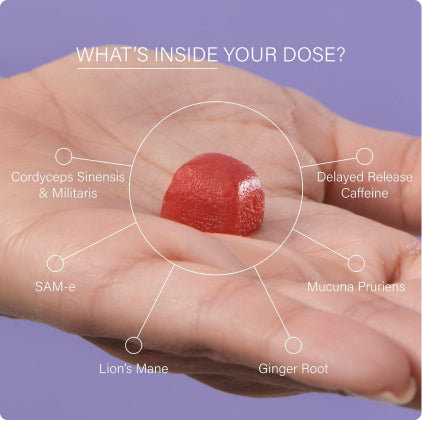
The right combination of adaptogens, nootropics, and functional mushrooms can help support more stable energy, clearer thinking, and better cognitive endurance through that window.
Not by overriding your biology.
By working with it.
The Real Advantage
Most people fade in the afternoon.
They accept it.
Or they fight it poorly.
But if you understand what’s happening, and you plan for it, you create separation.
You make fewer mistakes.
You think more clearly.
You protect your best work from your worst hours.
The afternoon slump isn’t going away.
But how you handle it is a choice.
And if you can stay sharp when everyone else is slowing down, that’s not just productivity.
That’s an edge.