If you were asked to guess where the world's healthiest elderly population lived, you might picture a wealthy European country with world-class healthcare, cutting-edge medicine, and access to every modern convenience imaginable.
You probably wouldn't picture a small chain of subtropical islands sitting hundreds of miles south of mainland Japan.
Yet for decades, Okinawa has fascinated scientists, doctors, and longevity researchers for precisely that reason.
The islands became famous for an astonishing statistic: Okinawa was home to one of the highest concentrations of centenarians in the world. Men and women routinely lived into their nineties and beyond, and many did so while remaining active, independent, and mentally sharp. Researchers weren't simply interested in how long these people lived. What captured their attention was how well they seemed to age.
In much of the developed world, growing older is often accompanied by a familiar pattern. Energy declines. Mobility becomes more limited. Chronic disease becomes more common. Memory begins to fade. Many people assume these changes are an unavoidable part of aging.
Okinawa appeared to challenge that assumption.
When researchers arrived hoping to uncover the secret, many expected to find a specific food, supplement, or genetic advantage that explained everything. Instead, what they discovered was something both more complicated and more interesting. The extraordinary health of Okinawa's elderly population wasn't the result of a single factor. It emerged from an entire way of life, one that had been quietly shaped over generations.
Diet was an obvious place to start.
Traditional Okinawan meals looked remarkably different from what many people in North America eat today. For much of the twentieth century, the diet was built around sweet potatoes, vegetables, seaweeds, legumes, herbs, and modest portions of fish. Highly processed foods were virtually nonexistent, and meals tended to be nutrient-dense without being calorie-heavy.
Just as important was the cultural attitude toward eating itself. Many Okinawans follow a practice known as hara hachi bu, a Confucian-inspired teaching that encourages people to stop eating when they are about 80 percent full. Rather than treating fullness as the goal, the habit encourages moderation and mindfulness, a simple practice that researchers believe may have contributed to healthier body weights and reduced metabolic stress throughout life.
But food alone could not explain what scientists were seeing.
The more time researchers spent on the islands, the more they realized that longevity in Okinawa wasn't built around isolated health interventions. It was woven into everyday life. Physical activity, for example, wasn't something scheduled between meetings or squeezed into an hour at the gym. Movement happened naturally throughout the day. Older adults gardened, walked to visit neighbours, tended small farms, prepared meals, and remained physically engaged in their communities well into old age.
This constant, low-intensity movement appears to be one of the defining characteristics of many long-lived populations around the world. Rather than cycling between sedentary lifestyles and bursts of exercise, people simply kept moving.
Yet perhaps the most surprising discovery had nothing to do with food or fitness at all.
Many Okinawans speak about a concept known as ikigai, often translated as "a reason for being." It refers to the sense that life has meaning, purpose, and value beyond mere existence. Whether that purpose comes from family, work, community, faith, or personal passions, it provides a reason to get up each morning and continue contributing to the world around you.
Researchers increasingly believe this may matter more than we once thought. A growing body of evidence suggests that people with a strong sense of purpose tend to experience better health outcomes, lower rates of depression, and even greater longevity. In Okinawa, purpose is not viewed as something reserved for youth or working age. It remains important throughout life.
Equally important were the social connections that surrounded people as they aged. Traditionally, many Okinawans belonged to lifelong support networks known as moai. These groups often began in childhood and continued for decades, providing friendship, emotional support, financial assistance when needed, and a deep sense of belonging. Long before scientists began studying the health effects of loneliness, Okinawan culture had already built community into daily life.
Today, researchers recognize social isolation as a significant risk factor for both physical and cognitive decline. Strong relationships appear to protect not only emotional wellbeing but also long-term health.
As scientists continued investigating Okinawa, another theme emerged repeatedly: stress.
Life on the islands was not free from hardship. Poverty, war, and economic uncertainty have all shaped Okinawan history. Yet traditional lifestyles often incorporated practices that helped prevent stress from becoming a permanent state. Close-knit communities, time spent outdoors, meaningful social roles, and a slower pace of life all appeared to provide buffers against the chronic stress that has become so common in modern society.
This matters because researchers now understand that chronic stress affects far more than mood. Elevated stress hormones over long periods can influence sleep, immune function, cardiovascular health, inflammation, and cognitive performance. In many ways, stress may act as an accelerator of aging itself.
It was during these investigations into traditional Okinawan lifestyles that researchers also became interested in some of the region's longstanding wellness practices, including the use of medicinal mushrooms.
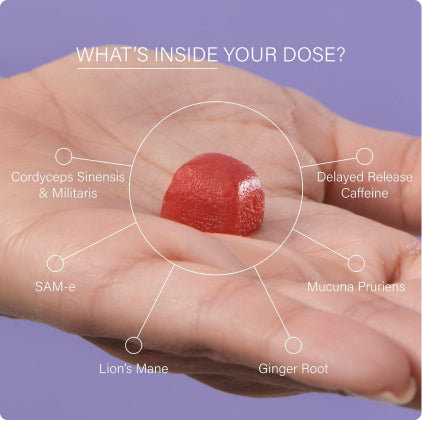
For centuries, cultures throughout East Asia have valued mushrooms such as Reishi for their association with vitality, resilience, and healthy aging. Modern scientists continue to study these mushrooms for their potential role in supporting stress management, immune health, and overall wellbeing. Lion's Mane has attracted particular interest in recent years because of its relationship to brain health and cognitive function, making it one of the most researched functional mushrooms in the world today.
Of course, no mushroom explains Okinawa's longevity on its own. In fact, that may be the most important lesson of all.
When people search for the secret to a long life, they often hope to find a single answer. A miracle food. A supplement. A breakthrough therapy.
Okinawa offers a different perspective.
The remarkable health of its people appears to be the result of countless small behaviours repeated consistently over decades. Nutritious food. Daily movement. Strong relationships. A sense of purpose. Effective stress management. Time spent in nature. Traditions that support health rather than undermine it.
None of these habits seem revolutionary on their own.
Together, however, they helped create one of the most extraordinary longevity stories the world has ever seen.
And perhaps that is why Okinawa continues to fascinate researchers today. Its greatest lesson is not that healthy aging requires something exotic or unattainable. It is that the foundations of a long, vibrant life may be far simpler, and far more human, than we often imagine.
Table of contents