Imagine trying to explain an office job to someone living 15,000 years ago.
"You'll wake up at 6:30. Sit in a chair for eight hours. Stare at a glowing rectangle. Ignore every sound around you. Don't move around too much. Don't interrupt. Don't get distracted. Don't daydream. Don't check what's happening outside. And whatever you do, keep your attention fixed on one task at a time."
They'd probably think we'd gone mad.
For almost all of human history, that wasn't how humans lived.
Long before cities, offices and smartphones, our ancestors survived by paying attention to everything. A rustle in the bushes could be prey. Or it could be a predator. A strange cloud formation might signal tomorrow's weather. An unfamiliar trail might lead to food, shelter or danger.
The people who noticed more often often survived more often.
That observation has led some evolutionary psychologists to suggest that many of the traits we now associate with ADHD may have been far more useful in prehistoric environments than they are in the modern world.
It's an intriguing idea. Not a settled scientific fact, but one possible explanation for why these traits have remained relatively common throughout human history instead of disappearing over time.
Think about some of the characteristics commonly associated with ADHD.
Curiosity.
Novelty seeking.
High energy.
Rapid shifts in attention.
Creativity.
A willingness to explore.
The ability to react quickly.
In today's world, those same traits can sometimes become obstacles.
You're halfway through a report when your phone buzzes.
An email arrives.
Someone starts talking nearby.
You remember something you forgot to do.
Suddenly your attention has moved somewhere else.
But place those same characteristics into a world where survival depends on spotting movement in the trees, discovering new territory or reacting instantly to unexpected danger, and they begin to look very different.
The trait hasn't necessarily changed.
The environment has.
That distinction matters.
ADHD is a genuine neurodevelopmental condition. For millions of people, it creates very real challenges with executive function, organisation, emotional regulation and sustaining attention. Those struggles shouldn't be dismissed or romanticised.
But history reminds us that context matters.
Qualities that are valuable in one environment can become liabilities in another.
The Industrial Revolution rewarded routine, punctuality and repetition.
The Information Age rewards deep concentration, digital organisation and constant cognitive control.
Modern work often asks us to do something that would have been extraordinarily rare for most of human history: sit still, ignore everything happening around us and focus on one abstract task for hours at a time.
That's a remarkably new expectation for a brain shaped over hundreds of thousands of years.
Ironically, we've also created the most distracting environment our species has ever experienced.
Every notification competes for your attention.
Every app is engineered to keep you engaged.
Every platform wants one more click, one more scroll and one more minute of your time.
Even people without ADHD often feel mentally exhausted by the constant stream of interruptions.
Perhaps the surprising thing isn't that so many people struggle to focus.
It's that any of us manage to focus at all.
The good news is that understanding this changes the conversation.
Instead of asking, "What's wrong with my brain?"
We can start asking, "How do I help my brain perform at its best?"
You can't redesign modern society.
Emails aren't going away.
Neither are meetings, social media or smartphones.
But you can build habits that make focus easier.
Getting enough sleep.
Moving your body.
Reducing unnecessary distractions.
Fueling your brain well.
And for many people, supporting the biology behind focus itself.
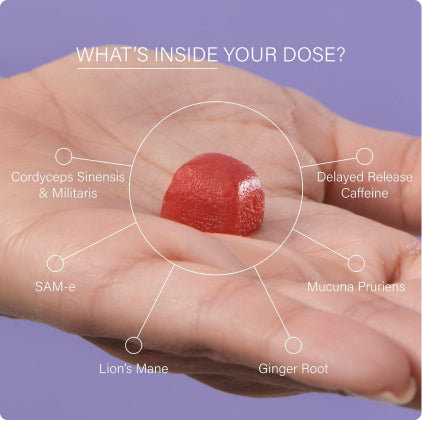
That's the philosophy behind Mojo.
We don't believe your brain is broken.
We believe modern life places extraordinary demands on it.
More information.
More decisions.
More interruptions.
More mental load than any generation before us has had to process.
Our goal isn't to change who you are.
It's to help you meet the demands of the world you actually live in.
Whether you're managing ADHD, struggling to stay focused at work or simply feeling mentally drained by modern life, we believe your brain deserves support - not because it's defective, but because it's working harder than ever before.
Maybe ADHD wasn't invented by the modern world.
But it's entirely possible that the modern world has made living with it more difficult than ever.
And that's exactly why Mojo exists.
Table of contents