No one meant for this to happen.
There was no meeting, no master plan, no moment where someone stood up and said, “Let’s make it impossible for people to focus.”
And yet, somewhere along the way, that’s exactly what we did.
It Started With a Simple Idea
The goal was straightforward: make things easier.
Faster communication. More information. More access. Better tools.
At every step, the logic made sense.
Email replaced letters. Smartphones removed waiting. Social feeds replaced searching.
Each innovation solved a real problem. And quietly introduced a new one.
The Shift No One Noticed
For most of human history, attention was stable.
You chose what to read, what to watch, what to think about. Focus was something you directed.
Now, it’s something that gets pulled.
Constantly.
Not because you’re weak or undisciplined, but because the environment changed around you.
The Rise of the Infinite Feed
The real shift wasn’t just technological. It was structural.
Information stopped being something you sought out, and became something that came to you, endlessly.
Endless scroll. Auto-play. Algorithmic recommendations.
There’s no natural stopping point anymore. No signal to pause. No built-in reason to disengage.
That’s not a flaw. It’s a feature.
The Variable Reward Loop
Underneath it all is a simple idea borrowed from behavioral psychology.
Unpredictable rewards are the most addictive.
Not every post is good. Not every video lands. But some do.
And your brain keeps searching for the next one.
It’s the same mechanism used in slot machines, just repackaged into something socially acceptable and always within reach.
The Cost of Always-On Attention
The human brain wasn’t built for this level of input.
Not the volume, not the speed, and definitely not the fragmentation.
So it adapts.
Attention starts to splinter. You switch tasks more often. You struggle to stay with one idea long enough to do meaningful work. You feel busy, but not productive.
It doesn’t feel like a system problem.
It feels like a personal one.
The Invisible Trade-Off
We gained access to everything.
But we gave up depth.
The ability to sit with a problem, to think clearly, to follow a thought all the way through. Those are the first things to go when attention becomes fragmented.
And once that starts to slip, everything feels harder than it should.
Why This Feels Personal
Most people internalize it.
“I can’t focus.”
“I’m too distracted.”
“I just need more discipline.”
But zoom out for a second.
You’re operating inside a system designed to interrupt you, over and over again.
Of course it feels difficult.
The Biology Catches Up
This isn’t just about habits or behavior.
It’s biological.
Constant stimulation changes how your brain operates. It affects dopamine regulation, increases mental fatigue, and lowers your baseline motivation.
Which is why, even when you want to focus, it feels harder than it used to.
The Wrong Solution
The natural response is to push harder.
More caffeine. More pressure. More forcing it.
And sometimes that works, temporarily.
But it’s not a real solution. It’s just adding more stress to a system that’s already overloaded.
The Real Shift
The shift isn’t about trying harder. It’s about changing the conditions.
Reducing the noise. Supporting the system. Rebuilding your capacity to focus.
Because focus isn’t just a skill you decide to use.
It’s a state your brain has to be able to access.
Why This Matters for Mojo
Mojo isn’t built for a world that existed 20 years ago.
It’s built for the one we’re living in now.
A world where attention is constantly under pressure, mental clarity is harder to access, and energy is inconsistent.
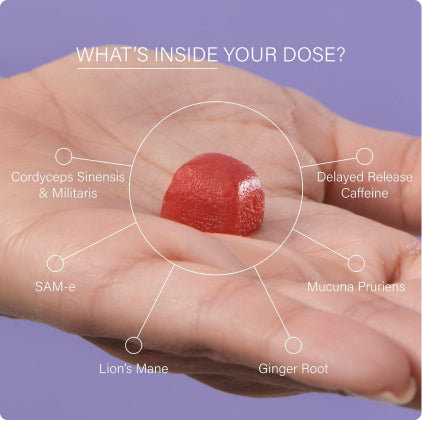
That’s why the formula is designed to support cognitive function, smooth out overstimulation, and help you sustain focus over time.
Not by spiking you.
By stabilizing you.
The Real Takeaway
We didn’t lose our ability to focus overnight.
We slowly designed it out of our environment.
And now we’re trying to rebuild it.
The good news is, it’s still there.
It just needs the right conditions to come back.
Table of contents