In 1936, a doctor named Charles Bradley ran a strange experiment at a hospital for children with behavioral problems in Rhode Island.
The kids weren’t lazy.
They weren’t stupid.
And they weren’t “bad.”
Most were described the same way:
Restless.
Distracted.
Impulsive.
Unable to focus in school.
Always in trouble.
Today, many of them would likely be diagnosed with Attention Deficit Hyperactivity Disorder.
But back then, nobody really understood what was happening.
And then something weird happened.
Bradley gave the children a stimulant drug called Benzedrine, mostly to help with headaches after medical procedures.
What happened next shocked him.
The children became calmer.
More focused.
More emotionally regulated.
Teachers reported dramatic improvements in school performance.
Some children who had struggled for years suddenly became engaged learners almost overnight.
It made no sense at the time.
Why would a stimulant calm hyperactive children down?
That question would eventually become one of the foundations of modern ADHD research.
But the deeper story is even more interesting.
Because long before ADHD had a diagnosis, history is filled with people who likely lived with it.
Inventors.
Explorers.
Writers.
Entrepreneurs.
Military commanders.
People obsessed with novelty.
People who chased stimulation.
People who struggled with structure but thrived in chaos.
Some historians believe figures like Leonardo da Vinci displayed many classic ADHD traits:
Jumping obsessively between projects.
Periods of intense hyperfocus.
Difficulty completing commissioned work.
Constant curiosity.
Restlessness.
Endless notebooks full of unfinished ideas.
Even modern psychologists have speculated that Thomas Edison and Winston Churchill may have shown similar patterns.
Of course, we can’t diagnose historical figures retroactively.
But it raises a fascinating question:
What if the same traits that make modern life difficult were once adaptive?
Thousands of years ago, the highly alert, novelty-seeking, risk-tolerant person may have been incredibly valuable.
The hunter.
The scout.
The explorer.
The person awake at every sound while others slept.
There’s even a theory called the “hunter vs farmer” hypothesis, proposed by writer Thom Hartmann, suggesting ADHD-type brains may have evolved for environments that rewarded rapid scanning, quick reactions, and constant environmental awareness rather than sitting still for 8 hours under fluorescent lights.
And honestly… modern life may be uniquely brutal for those brains.
Notifications.
Open office noise.
Infinite scrolling.
Constant context switching.
Endless digital stimulation.
We live in an economy designed to fracture attention.
Which is probably why so many adults now feel mentally overloaded, distracted, foggy, or unable to focus deeply for sustained periods.
Not because they’re broken.
Because their environment is fighting for their attention every second of the day.
And that’s where things get interesting.
Because the conversation around ADHD is changing.
For years, focus was treated like pure discipline.
Now we increasingly understand it’s also biological.
Sleep matters.
Stress matters.
Diet matters.
Movement matters.
Brain chemistry matters.
Even ingredients like L-Theanine, caffeine timing, Lion’s Mane mushroom, and adaptogens are being studied for their impact on focus, mental clarity, and cognitive performance.
Not as magic solutions.
Not as replacements for medical advice.
But as tools that may help support cognitive function and smoother energy throughout the day.
That’s part of the thinking behind Mojo.
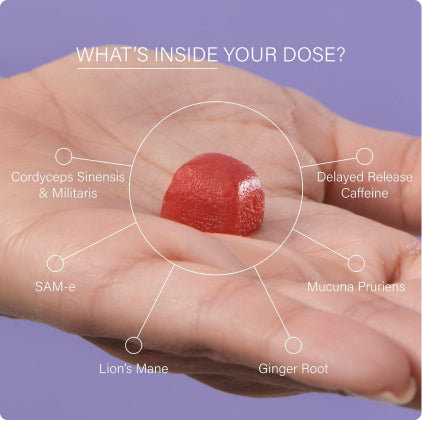
Instead of the harsh spike-and-crash feeling many people get from overloaded energy drinks or endless coffee, Mojo combines ingredients like slow-release caffeine, L-Theanine, Lion’s Mane, Cordyceps, and Panax Ginseng to support calmer, steadier focus and mental clarity.
Because for a lot of people, the goal isn’t becoming a productivity robot.
It’s just feeling a little less scattered.
A little more present.
A little more capable of finishing what they start.
And maybe that’s the bigger lesson hidden in the history of ADHD.
Some brains were never designed for endless spreadsheets, constant notifications, and sitting perfectly still all day.
But with the right environment, routines, sleep, movement, and support, those same brains can also become incredibly creative, energetic, curious, and driven.
The boy who couldn’t sit still may never have been broken at all.
Table of contents