For a long time, the popular picture of ADHD was pretty simple.
A kid who couldn’t sit still.
Bad grades. Constant interruptions. Staring out the window while the teacher was talking.
And while that version of ADHD certainly exists, our understanding of the condition has become considerably more nuanced.
Especially when it comes to adults.
A major 2025 review in World Psychiatry estimated that adult ADHD affects around 2.5% of adults worldwide, while up to 70% of people who had ADHD in childhood may continue experiencing impairing symptoms as adults, even if they no longer meet the full diagnostic criteria.
In other words: ADHD doesn't necessarily disappear when you turn 18.
It can change.
And sometimes the systems you've built around yourself simply get good enough to hide it.
So whether you've been diagnosed, suspect you might have ADHD, or occasionally wonder why your brain seems to require a looming catastrophe before it will answer an email...
here's what the research says is actually worth knowing.
1. ADHD isn't simply “not being able to pay attention”
This is probably the biggest misconception.
People with ADHD can sometimes focus extraordinarily well.
The difficulty is often controlling where that attention goes and when.
A major 2025 review of adult ADHD research found evidence of differences across several areas of executive functioning, including working memory, sustained attention, inhibition, decision-making and planning.
That helps explain something that otherwise seems contradictory.
Someone can be incredibly capable of concentrating on something interesting while struggling enormously with something mundane.
You might spend three hours researching the perfect espresso machine...
then walk past the dishwasher you meant to empty six times.
The question isn't always:
Can I focus?
It's often:
Can I direct my focus toward the thing I actually need to be doing?
That distinction explains a lot.
2. Hyperfocus doesn't necessarily contradict ADHD
This one confuses people.
“How can I have ADHD? I spent six hours researching mechanical keyboards last night.”
But ADHD isn't necessarily an inability to concentrate.
People with ADHD commonly report periods of intense absorption in interesting or stimulating activities, sometimes called hyperfocus.
The problem is control.
The same person who can disappear into an obsession for an entire evening might find it surprisingly difficult to shift their attention toward something less stimulating.
Which is why ADHD can produce the slightly absurd situation where you've learned everything there is to know about Japanese denim...
but still haven't booked the dentist appointment you've been thinking about for four months.
3. Adult ADHD can hide surprisingly well
Not everyone with ADHD looks chaotic from the outside.
Some people become extremely good at building systems around themselves.
Calendars.
Alarms.
Lists.
Routines.
Exercise.
Artificial deadlines.
Working late because urgency finally makes the brain switch on.
The CDC's updated 2026 guidance on adult ADHD specifically notes that symptoms can look different in adults and may become more apparent when the demands of adulthood increase.
Someone may have functioned reasonably well at school, then struggle when life suddenly requires them to independently manage a career, finances, relationships, children, appointments and approximately 14,000 passwords.
That doesn't mean ADHD suddenly appeared at 35.
Under current diagnostic criteria, symptoms need to have been present during childhood.
But sometimes adulthood removes the structure that was keeping everything together.
4. Motivation can work differently
Everyone procrastinates.
But ADHD is associated with differences in executive functioning and reward-related processes that can make starting certain tasks particularly difficult.
You know exactly what you need to do.
You want to do it.
You may even be annoyed with yourself for not doing it.
And yet...
nothing.
Then the deadline gets close.
Suddenly there's urgency.
And somehow the thing you've avoided for three weeks gets completed in three hours.
The problem is that if urgency becomes your primary motivational system, life can become a sequence of self-created emergencies.
Sometimes the solution isn't more motivation.
It's making the starting point smaller.
Don't “write the presentation.”
Open the document.
Don't “clean the house.”
Put away five things.
Don't “work out.”
Put your shoes on.
Getting started is often the hardest transition.
5. “Time blindness” is more than an internet meme
This is one of the areas where the evidence has become particularly interesting.
A systematic review and meta-analysis examining 824 effect sizes found a meaningful overall difference in time perception among people with ADHD.
Researchers study this through things like estimating durations, reproducing time intervals and managing time.
So while “time blindness” isn't itself an official diagnostic criterion, difficulties with time perception and time management are supported by research.
Which might help explain the ADHD experience of thinking:
I'll leave in five minutes.
Followed somehow by:
Why am I 17 minutes late?
Externalizing time can help.
Use visible clocks.
Set timers.
Put things in your calendar immediately.
Create deadlines before the real deadline.
Because “I'll remember later” is occasionally one of the greatest lies the human brain has ever told itself.
6. ADHD may involve emotional regulation too
This is an increasingly important part of the conversation.
Emotional dysregulation isn't currently one of the defining diagnostic criteria for ADHD, and researchers are still debating exactly where it fits.
But the association is difficult to ignore.
A meta-analysis involving 2,535 adults found substantially higher emotional dysregulation among adults with ADHD than controls.
And a 2025 meta-analysis covering 80 studies and more than 6,000 participants also found poorer performance across measures of emotional processing in people with ADHD.
That doesn't mean every emotional reaction is “because of ADHD.”
But it helps explain why some people describe ADHD as affecting much more than concentration.
Frustration.
Impatience.
Emotional intensity.
Difficulty calming down after something goes wrong.
Researchers are increasingly interested in whether these are important parts of the ADHD picture rather than unrelated personality traits.
7. Exercise might actually help
This is one of the more encouraging findings from recent research.
A 2025 systematic review and meta-analysis looked specifically at physical activity interventions in adults with ADHD.
The researchers found evidence that acute exercise, particularly cardio, can reduce ADHD symptoms in the short term, while longer-term exercise may help too.
There's an important caveat: the researchers also said much of the available evidence was relatively weak and showed signs of publication bias.
So we're not talking about replacing established ADHD treatment with a morning jog.
But movement appears to be a useful part of the toolkit.
And unlike many things promising to improve your brain on the internet, exercise has plenty of other reasons to recommend it anyway.
8. There still isn't one magic ADHD treatment
This is worth emphasizing because the internet loves a miracle cure.
A huge 2025 BMJ umbrella review pulled together 221 previous meta-analyses examining ADHD interventions.
The overall picture was messy.
Some treatments had considerably stronger evidence than others. Medication remains an important evidence-based treatment for many people with ADHD, while evidence for various non-drug approaches varies considerably in quality and certainty.
A separate 2025 Lancet Psychiatry analysis also compared pharmacological, psychological and neurostimulatory interventions for adults with diagnosed ADHD.
The lesson isn't that everyone should take medication.
It's that ADHD treatment should be individualized and discussed with an appropriate healthcare professional rather than assembled from whichever TikTok appeared on your feed last night.
9. Social media has helped... and complicated things
There's an obvious upside to millions of people talking openly about ADHD.
People recognize experiences they previously thought were personal failures.
Adults seek assessments.
Parents understand their children better.
Stigma decreases.
But there's an equally obvious problem.
Almost everyone occasionally procrastinates.
Almost everyone loses their keys.
Almost everyone gets distracted.
And after spending enough time online, almost everyone has wondered whether they have ADHD.
That doesn't mean they do.
In fact, this month JAMA reported on the enormous increase in adults seeking ADHD assessments and the challenge clinicians face distinguishing ADHD from things that can produce similar symptoms.
There is no single test that says ADHD: YES / NO.
Diagnosis involves looking at the pattern of symptoms, whether they interfere with everyday functioning, whether they appear across multiple settings and whether evidence of symptoms stretches back into childhood.
Clinicians may also need to rule out things like anxiety, depression, sleep problems, substance use and other conditions that can sometimes look remarkably similar.
So if you recognize yourself in this article, that's useful information.
It isn't a diagnosis.
10. Your environment matters more than you think
This might be the most immediately useful lesson whether you have ADHD or not.
If your attention is easily captured...
stop making your brain fight unnecessary battles all day.
Put the phone somewhere you physically cannot reach it.
Close the tabs.
Turn off notifications.
Use headphones.
Work somewhere boring.
Create visible reminders.
Break intimidating projects into ridiculously small first steps.
Make the behaviour you want easier to begin and distractions slightly more annoying to access.
You don't get bonus points for resisting temptation.
Removing the temptation works too.
And finally: the goal isn't becoming a productivity robot
This might be the part we forget.
Managing attention isn't about squeezing another 17% of productivity from every waking hour.
It's about having more control over where your mind goes.
Sometimes that's work.
Sometimes it's listening when someone you love is talking.
Sometimes it's reading a book without reaching for your phone.
Sometimes it's simply being able to sit somewhere quietly without immediately needing another hit of stimulation.
And that isn't exclusively an ADHD problem anymore.
Modern life has become remarkably good at fragmenting everyone's attention.
Notifications. Infinite feeds. Email. Slack. Streaming. News. Short-form video.
A tiny supercomputer permanently sitting six inches from your hand.
So whether you've been diagnosed with ADHD, think you might have it, or simply recognize some of these behaviours in yourself, many of the fundamentals are remarkably similar.
Protect your sleep.
Move your body.
Create structure.
Externalize things you struggle to remember.
Reduce unnecessary distractions.
Understand what makes your brain switch on.
And if these problems are significantly interfering with your work, relationships or everyday life, talk to a qualified healthcare professional.
Because perhaps the most useful thing we've learned about ADHD isn't some clever productivity trick.
It's that understanding how your attention works gives you a much better chance of deciding where you want to put it.
A little help when you want to lock in
That philosophy is also part of why we made Mojo.
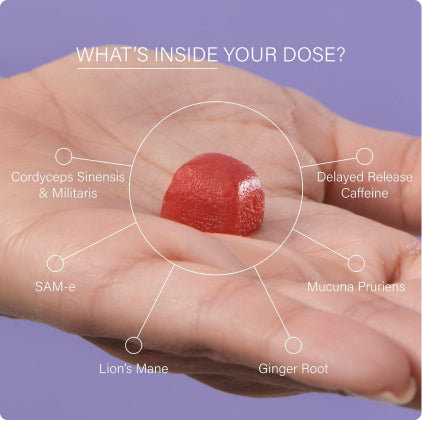
Mojo combines functional ingredients including cordyceps, lion's mane and kanna in a convenient gummy designed to support focus, energy and mental clarity.
It's not an ADHD medication or treatment, and we don't pretend it is.
Think of it as another tool in the toolkit alongside sleep, exercise, structure, good routines and protecting your attention.
Because your brain has enough competing for it already.
Table of contents