In the late 1990s, as Japan faced one of the world’s fastest-aging populations, researchers were racing against a quiet crisis.
Memory decline.
Cognitive impairment.
An aging society searching for solutions that weren’t sedatives or stimulants.
What they found didn’t come from a pharmaceutical lab.
It came from a mushroom.
An unusual finding in Japanese clinical research
Japanese researchers began publishing a series of clinical studies examining a mushroom called Hericium erinaceus, known commonly as Lion’s Mane.
Unlike many supplements tested at the time, the results were… strange.
Adults with mild cognitive impairment showed measurable improvements in:
-
Memory
-
Focus
-
Cognitive clarity
But here’s the part that caught scientists’ attention:
When participants stopped taking Lion’s Mane, the cognitive improvements gradually declined.
Not overnight.
Not dramatically.
But consistently.
This wasn’t how stimulants behaved.
Why researchers paid attention
Most “brain boosters” follow a predictable pattern:
-
Take them → feel sharper
-
Stop taking them → effect disappears immediately
Lion’s Mane didn’t work that way.
The delayed decline suggested something different was happening — not stimulation, but support.
Researchers began to hypothesize that Lion’s Mane wasn’t pushing the brain harder, but helping it function better at a structural level.
That idea alone was enough to raise eyebrows.
The nerve growth factor connection
Further investigation revealed something unusual about Lion’s Mane.
It appeared to stimulate the production of nerve growth factor (NGF) — a protein essential for:
-
Neuron growth
-
Neuron maintenance
-
Neural repair
NGF is notoriously difficult to influence naturally.
Very few compounds are known to affect it at all.
Which made the findings even more compelling.
If true, this meant Lion’s Mane wasn’t masking cognitive decline.
It might be supporting the underlying systems responsible for memory and focus.
From research papers to grocery shelves
These early studies didn’t stay confined to academic journals.
They helped ignite Japan’s functional food movement in the early 2000s — a category focused on foods that support specific physiological functions.
Lion’s Mane quickly found its way into:
-
Teas
-
Powders
-
Extracts
-
Everyday wellness products
Not as a miracle cure.
But as something rare: a natural compound with measurable neurological relevance.
Why the “drop-off” mattered most
The most telling detail wasn’t the improvement.
It was what happened when supplementation stopped.
The gradual decline reinforced a key idea:
Lion’s Mane wasn’t acting like caffeine.
It wasn’t hijacking neurotransmitters.
It wasn’t forcing alertness.
It was behaving more like nutrition for the brain — beneficial while present, and missed when removed.
For researchers, that distinction mattered.
For modern life, it matters even more.
What this means today
Fast forward to now.
We live in a world of:
-
Constant distraction
-
Mental fatigue
-
Cognitive overload
-
“Energy” products that feel aggressive, not supportive
Lion’s Mane offers a different proposition.
Not louder thinking.
Not frantic focus.
But clearer, steadier cognition.
The same reason Japanese researchers took it seriously decades ago is the reason it resonates today.
It doesn’t shout.
It supports.
Why Lion’s Mane belongs in the modern conversation
The Japanese studies didn’t promise superhuman intelligence.
They didn’t sell instant genius.
They documented something far more interesting:
a natural ingredient that appeared to help the brain function as it was designed to.
Quietly.
Gradually.
Sustainably.
Sometimes, the most important discoveries don’t explode overnight.
They just keep showing up in the data.
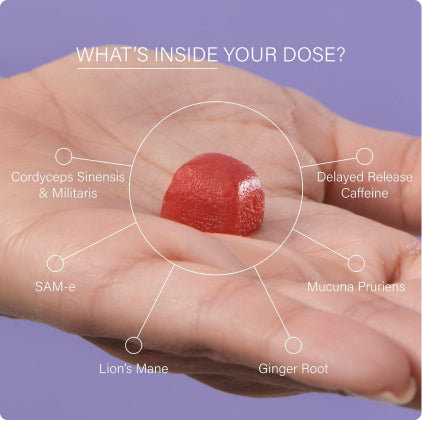
That’s exactly why Lion’s Mane sits at the core of Mojo Brain Boost.
Not as a shortcut.
Not as a stimulant.
But as foundational support for focus, clarity, and cognitive endurance — the kind that shows up day after day, not just in a rush.
Because the goal was never louder thinking.
It was better thinking, supported the way nature intended.
Table of contents